Tampilkan postingan dengan label sunlight. Tampilkan semua postingan

Rabu, 28 Desember 2011

Wash Your Clothes Using Sunlight


Material scientists have developed a new cotton fabric that cleans itself of stains and bacteria when exposed to sunlight. This would mean you could transform your garments from stinky to sparkly simply by simply hanging them out in the sunshine.

..........................................................................................................................................................
...........................................................................................................................................................


Mingce Long and Deyong Wu from Donghua University developed the fabric using a coating made from a compound of titanium dioxide and nitrogen. This breaks down stains and kills microbes when exposed to some types of light.
Titanium dioxide has already found uses in self-cleaning windows, kitchen and bathroom tiles. The authors admit that there are already other self-cleaning fabrics but these tend to work most efficiently when exposed to intense ultraviolet rays. This coating works within the visible spectrum.


Fabric coated with the material could easily remove an orange dye stain when exposed to sunlight. Further nanoparticles made from silver and iodine helps to accelerate the discoloration process. The coating even remains after washing and drying the clothes. Although presumably that wouldn't be necessary if the Sun already did the leg-work.
The study appears in ACS Applied Materials & Interfaces
Environment Clean Generations

Senin, 14 November 2011

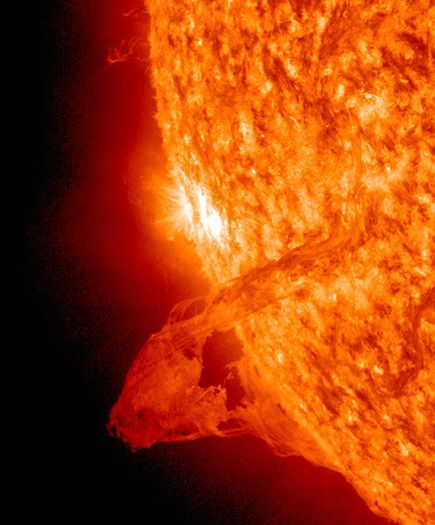
The Hidden Sunlight Phenomenon, Fiery Aurora

The unprecedented effect of sunlight reveals a whole new story in the mind of scientists that how sunlight transmit from space to air. The strange effect of fiery aurora is happening around the sun that ejects various gases in the space to be utilized for emitting the combination of different particles of gases that has shown in air in the form of different colored particles. The perfect example of this phenomenon has been seen while sun rays fall on Venus shows orange, blue and purple color depending upon the nature of gaseous particles.
All along the way, while these rays touch on earth intimate an immense amount of positive energy that is suitable for beings and plants to absorb the sufficient amount of rays. This heavy effects starts from the South Pole and gradually slows down while moving towards the North Pole. This aurora phenomenon is responsible for implanting the feasible conditions for the survival of mankind. You can see some images to visualize the effects as happening naturally.


Rabu, 19 Oktober 2011

Hydrogen from Solar Panels


While roofs across the world sport photovoltaic solar panels to convert sunlight into electricity, a Duke University engineer believes a novel hybrid system can wring even more useful energy out of the sun's rays.

nstead of systems based on standard solar panels, Duke engineer Nico Hotz proposes a hybrid option in which sunlight heats a combination of water and methanol in a maze of glass tubes on a rooftop. After two catalytic reactions, the system produces hydrogen much more efficiently than current technology without significant impurities. The resulting hydrogen can be stored and used on demand in fuel cells.

For his analysis, Hotz compared the hybrid system to three different technologies in terms of their exergetic performance. Exergy is a way of describing how much of a given quantity of energy can theoretically be converted to useful work.


"The hybrid system achieved exergetic efficiencies of 28.5 percent in the summer and 18.5 percent in the winter, compared to 5 to 15 percent for the conventional systems in the summer, and 2.5 to 5 percent in the winter," said Hotz, assistant professor of mechanical engineering and materials science at Duke's Pratt School of Engineering.


The paper describing the results of Hotz's analysis was named the top paper during the ASME Energy Sustainability Fuel Cell 2011 conference in Washington, D.C. Hotz recently joined the Duke faculty after completing post-graduate work at the University of California-Berkeley, where he analyzed a model of the new system. He is currently constructing one of the systems at Duke to test whether or not the theoretical efficiencies are born out experimentally.

Hotz's comparisons took place during the months of July and February in order to measure each system's performance during summer and winter months.

Like other solar-based systems, the hybrid system begins with the collection of sunlight. Then things get different. While the hybrid device might look like a traditional solar collector from the distance, it is actually a series of copper tubes coated with a thin layer of aluminum and aluminum oxide and partly filled with catalytic nanoparticles. A combination of water and methanol flows through the tubes, which are sealed in a vacuum.

"This set-up allows up to 95 percent of the sunlight to be absorbed with very little being lost as heat to the surroundings," Hotz said. "This is crucial because it permits us to achieve temperatures of well over 200 degrees Celsius within the tubes. By comparison, a standard solar collector can only heat water between 60 and 70 degrees Celsius."


Once the evaporated liquid achieves these higher temperatures, tiny amounts of a catalyst are added, which produces hydrogen. This combination of high temperature and added catalysts produces hydrogen very efficiently, Hotz said. The resulting hydrogen can then be immediately directed to a fuel cell to provide electricity to a building during the day, or compressed and stored in a tank to provide power later.


The three systems examined in the analysis were the standard photovoltaic cell which converts sunlight directly into electricity to then split water electrolytically into hydrogen and oxygen; a photocatalytic system producing hydrogen similar to Hotz's system, but simpler and not mature yet; and a system in which photovoltaic cells turn sunlight into electricity which is then stored in different types of batteries (with lithium ion being the most efficient).

"We performed a cost analysis and found that the hybrid solar-methanol is the least expensive solution, considering the total installation costs of $7,900 if designed to fulfill the requirements in summer, although this is still much more expensive than a conventional fossil fuel-fed generator," Hotz said.

Costs and efficiencies of systems can vary widely depending on location -- since the roof-mounted collectors that could provide all the building's needs in summer might not be enough for winter. A rooftop system large enough to supply all of a winter's electrical needs would produce more energy than needed in summer, so the owner could decide to shut down portions of the rooftop structure or, if possible, sell excess energy back to the grid.


"The installation costs per year including the fuel costs, and the price per amount of electricity produced, however showed that the (hybrid) solar scenarios can compete with the fossil fuel-based system to some degree," Hotz said. 'In summer, the first and third scenarios, as well as the hybrid system, are cheaper than a propane- or diesel-combusting generator."


This could be an important consideration, especially if a structure is to be located in a remote area where traditional forms of energy would be too difficult or expensive to obtain.

Hotz's research was supported by the Swiss National Science Fund. Joining him in the study were UC-Berkeley's Heng Pan and Costas Grigoropoulos, as well as Seung H. Ko of the Korea Advanced Institute of Science and Technology, Daejon.
by "environment clean generations"

Selasa, 18 Oktober 2011

Sillicon and Solar Power in the Desert

The forbidding sands of the Sahara might seem an unusual place for farming. But if you’re farming silicon to make solar panels, the conditions in the Sahara are more or less optimal. At least, that’s the thinking behind the Sahara Solar Breeder Project. The plan, a joint project proposed by Japanese and Algerian universities, would use the desert’s immense supplies of sunlight and sand to “breed” solar power plants and solar panel factories.


The idea is to start with a small number of silicon manufacturing plants that will churn out the silicon needed to manufacture solar panels. Once those panels are operating, they can be used to power the silicon plants, which in turn churn out more silicon and solar panels, which in turn can be used to power more silicon and solar energy plants. And so on. By 2050, the universities envision breeding enough silicon and solar by 2050 to supply half the world’s energy.

That’s a far more lofty goal than the Destertec Foundation’s goal of supplying just 15 percent of Europe’s energy by 2050. But some have questioned the Sahara Solar Breeder Project’s goal of using high-temperature superconductors to transmit direct current electricity over long distances, claiming that the cost of cooling the lines renders the project unfeasible. Keep in mind that superconductors have to be kept at very low temperatures, so “high-temperature” is a relative term, meaning they "only" have to be cooled to 400 degrees below zero.


The Breeder project thinks it can still make its energy cost-competitive, even with the added cost of cooling the transmission lines. Maybe they’re right; after all, it should only cost them some extra energy, and as long as that energy is supplied by their own solar panels it really shouldn’t add too significantly to costs. That’s assuming, of course, that the project can reach the critical mass needed to become an energy exporter that doesn’t consume all the energy it creates.


Still, it’s an interesting idea: Plant a solar power collector and a solar panel manufacturing plant in the desert and watch them grow, symbiotically. An organic, biologically-inspired notion of both manufacturing and power generation sounds attractive, and if the partners can make it thrive in the middle of the desert, more power to them.
 by "environment clean generations"