Tampilkan postingan dengan label pacific ocean. Tampilkan semua postingan

Senin, 31 Oktober 2011

Laser Orbital Debris Removal


Another week, another scheme to clean up our bourgeoning space debris problem. This one, like many before it, calls for a powerful ground-based laser to remove orbital debris from low earth orbit. Using high-powered laser pulses fired from the ground, the system would create a small plasma jet emanating from the piece of junk itself, essentially turning each piece of debris into its own laser-powered rocket that would remove itself from orbit.
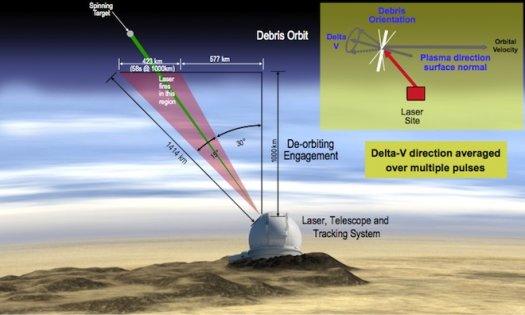
 The system, detailed in a paper released on arXiv last week, would rely on technologies already available or already under development. And unlike other ground-based laser systems proposed in past decades, it would be able to tackle both large and small pieces of space junk. A 33-foot telescope should do the trick, and a powerful enough laser isn’t out of reach, the authors of the paper claim.

Essentially, the heat from the laser--which would have to be targeted very precisely to intercept these extremely small objects whipping around the sky at many thousands of miles per hour--would vaporize a small part of each piece of space junk. The heat would be such that a small plasma jet would form, basically turning that piece of the space junk into fuel for a small jet that would push the debris out of orbit. Small piece of debris would burn up as their orbits decayed. Others would need to be carefully nudged out of orbit such that they end up landing in the Pacific Ocean.
The authors argue that a ground-based laser would obviate the need to launch any space junk-clearing spacecraft into orbit, which would cost hundreds of millions of dollars. Small pieces of junk could be cleared this way for a few thousand dollars. Larger pieces might cost up to $1 million.

Of course, laser-based approaches have been rejected out of hand previously based on the idea that they might also be used to target satellites in space during periods of hostilities. This scheme is likely headed for a similar fate. But at least someone is thinking about the problem, which as you read this is growing unchecked.
 by "environment clean generations"

Senin, 26 September 2011

The Next Pangaea Won't Fit


THE world's ultimate jigsaw puzzle will be missing a couple of pieces when it is next put together. A Pangaea-like supercontinent is forecast to form in 250 million years, but a new model predicts that superplumes rising from hotspots deep in the Earth's mantle will keep South America and Antarctica from re-merging with the other continents.


Supercontinents form, break apart, then form again every few hundred million years. Geophysicists have traced the process back to early in Earth's history by measuring magnetic fields in ancient rocks, and some have attempted to extrapolate from the present motion of the plates the likely shape of the next supercontinent.


That supercontinent is already beginning to form: Africa is slowly colliding with Europe, and the fringes of Australia have begun to collide with Asia. Most future projections have it that the Pacific will close as its crust continues to sink beneath Asia to the west and North America to the east, and that South America and Antarctica will eventually join the ultra-slow-motion train wreck to form a supercontinentMovie Camera variously dubbed "Amasia" or "Novopangaea". An alternative scenario, proposed by Christopher Scotese of the University of Texas at Arlington, predicts that the Atlantic, not the Pacific, will close, reconnecting the east coast of North America to Africa to form "Pangea Proxima".


Neither of these predictions takes into account two massive warm zones in the mantle, 2800 kilometres beneath Africa and the south Pacific. Evidence is growing that these superplumes are too important to ignore, though. They each appear to elevate the crust above them by 1 or 2 kilometres - enough to affect plate motion.


The hotspots appear to have formed hundreds of millions of years ago, says Masaki Yoshida of the Japan Agency for Marine-Earth Science and Technology in Yokosuka. They may even be remnants of the Earth's primordial mantle, according to a recent study that also suggested the hotspots are behind the appearance of large volcanic provinces that co-occurred with many mass extinction events

Now Yoshida and Madhava Santosh of Kochi University, Japan, have modelled how convection in the mantle - including the superplumes - will drive plate motion over the next 250 million years.

They report that the two plumes will deflect both South America and Antarctica. That will keep the Pacific open, with South America staying in the south and Antarctica remaining near the South Pole.


They are the first ones to make a quantified model of the effects of the plumes, says Kent Condie at the New Mexico Institute of Mining and Technology in Socorro. "You're not going to ride a continent up over one of these upwellings."


by "environment clean generations"