Tampilkan postingan dengan label bacteria. Tampilkan semua postingan

Senin, 16 Januari 2012

"Nano-Ear" Can Listen to the Songs of Bacteria


German researchers have turned an optical tweezer device into the world’s first “nano-ear” capable of detecting sounds six orders of magnitude below the threshold of human hearing. Using an optically trapped gold nanoparticle as their listening device, the team says they can now detect sounds made at the bacterial level or use their device to tune (or perhaps to test?) the minuscule MEMS machines of the future.

The nano-ear is pretty simple, considering that it relies on technology that has been laying around in the lab for decades now. Optical tweezers are laser devices that use light to trap or manipulate a small particle in a particular point in space by drawing the particle to the most intense point in the laser beam’s electric field. By trapping a gold nanoparticle in just such a optical trap and measuring the influence of various sound waves on that particle, the found that they can “listen” to very small vibrations.


That means sound analysis at extremely low levels. The gold nanoparticle itself is just 60 nanometers (that’s 60 billionths of a meter, or roughly a thousand times smaller than a human hair), which makes it pretty sensitive to very small forces. The researchers used both a “loud” source--a tungsten needle glued to a speaker that vibrates at roughly 300 Hz--and a second source made up of bunches of other gold nanoparticles heated by a second laser to vibrate at just 20 Hz. 


The nano-ear could hear them both loud and clear. The sound waves nudge the trapped gold nanoparticle in the same direction that the waves are propagating, allowing for precise measurement of the sound itself based on the particle’s motion. Experiments showed the nano-ear could detect vibrations down to about -60 decibels--or six orders of magnitude lower than human hears can. That means the device could be used to identify microorganisms or processes at the microscopic level by their sound signatures, or to help design and tune microelectrical mechanical systems.

Senin, 07 November 2011

Seven Billion People

On the last day of October 2011, the global population of an upstart branch of the primate order  will reach 7 billion.
In itself, not much: Seven billion is just a one-digit flicker from 6,999,999,999. But the number carries a deep existential weight, symbolising themes central to humanity's relationship with the rest of life on Earth.
For context, let's consider a few other numbers. The first: 10,000. That's approximately how many homo sapiens existed 200,000 years ago, the date at which scientists mark the divergence of our species from the rest of homo genus, of which we are the sole survivors.
From those humble origins, humans -- thanks to our smarts, long-distance running skills, verbal ability and skill with plants -- proliferated at an almost inconceivable rate.


Some may note that, in a big-picture biological sense, humanity has rivals: In total biomass, ants weigh as much as we do, oceanic krill weigh more than both of us combined, and bacteria dwarf us all. Those are interesting factoids, but they belie a larger point.
Ants and krill and bacteria occupy an entirely different ecological level. A more appropriate comparison can be made between humans and other apex predators, which is precisely the ecological role humans evolved to play, and which -- beneath our civilised veneer -- we still are.

According to a back-of-the-envelope calculation, there are about 1.7 million other top-level, land-dwelling, mammalian predators on Earth. Put another way: For every non-human mammal sharing our niche, there are more than 4,000 of us.Environment Clean Generations
In short, humans are Earth's great omnivore, and our omnivorous nature can only be understood at global scales. Scientists estimate that 83 per cent of the terrestrial biosphere is  under direct human influence. Crops cover some 12 per cent of Earth's land surface, and account for more than one-third of terrestrial biomass. One-third of all available fresh water is diverted to human use.

Altogether, roughly  20 per cent of Earth's net terrestrial primary production, the sheer volume of life produced on land on this planet every year, is harvested for human purposes -- and, to return to the comparative factoids, it's all for a species that accounts for .00018 per cent of Earth's non-marine biomass.
We are the .00018 per cent, and we use 20 per cent. The purpose of that number isn't to induce guilt, or blame humanity. The point of that number is perspective. At this snapshot in life's history, at -- per the insights of James C. Rettie, who imagined life on Earth as a year-long movie -- a few minutes after 11:45 pm on 31 December, we are big. Very big.

However, it must be noted that, as we've become big, much of life had to get out of the way. When modern Homo sapiens started scrambling out of East Africa, the average extinction rate of other mammals was, in scientific terms, one per million species years. It's  100 times that now, a number that  threatens to make non-human life on Earth collapse.
In regard to that number, environmentalists usually say that humanity's fate depends on the life around us. That's debatable. Humans are adaptable and perfectly capable of living in squalor, without clean air or clean water or birds in the trees. If not, there wouldn't be 7 billion of us. Conservation is a moral question, and probably not a utilitarian imperative.

But the fact remains that, for all of humanity to experience a material standard of living now enjoyed by a tiny fraction, we'd  need four more Earths. It's just not possible. And that, in the end, is the significance of 7 billion. It's a challenge.
In just a few minutes of evolutionary time, humanity has become a force to be measured in terms of the entirety of life itself. How do we,  the God species, want to live? For the answer, check back at 8 billion.

 read more
by "environment clean generations"

Senin, 24 Oktober 2011

Can Extremophiles Survive on Europa?


A team of astrobiologists from Argentina have recreated the conditions of Jupiter moon Europa, to see if extremophile bacteria could survive the unwelcoming conditions of the Jovian system.


Interplanetary space is generally considered lethal to organisms thanks to high levels of radiation, intense vacuum conditions and extreme temperatures. But the team, lead by Ximena Abrevaya at the University of Buenos Aires, wanted to see if any hardy critters could tough it out.

Finding a likely candidate would certainly help recent research at the National Autonomous University of Mexico, where researchers used a computer simulation to find if life could spread into space, hitchhiking on space-faring rocks.


That team found that particles ejected from the Earth could reach as far as Jupiter and one of its 64 moons, Europa, which astronomers reckon has a huge salt water ocean underneath its icy crust. A good breeding ground for life. But could anything survive the trip?


The team from Buenos Aires created a vacuum with conditions similar to those which exist on the surface of Europa. They then placed three organisms in it: the hypersaline-tolerent Natrialba magadii, the salt-obsessed Haloferax volcanii and the ultra-hardy, all-around survivor Deinococcus radiodurans.


The researchers then blasted these critters with ultraviolet radiation at levels that might occur on Europa. After three hours of extensive radiation, the results came back: none of the H. volcanii survived, but small numbers of D. radiodurans and N. magadii could tough out the toxic rays.


D. radiodurans are well-known survivors, often called the world's toughest bacteria for their ability to shrug off extremely low temperatures, a complete lack of water, deadly vacuums and acid. In a past experiment using simulated Martian soil, 30 percent of a community of D. radiodurans survived for 10 days. These guys are tough.


But now astrobiologists will want to take a closer look at N. magadii, to see if they're as hardy as D. radiodurans. The team writes, in the paper: "Much longer exposure times need to be tested to see if at least a small number of cells of N. magadii and D. radiodurans could survive the V-UV and vacuum damages present in space without any protection."


Studying to see if microbes have the ability to survive in space conditions has many applications in astrobiology. "For example, it is important to develop planetary protection procedures, life support systems and energy fuel cells based on a number of microbial species," the team writes.


"It is also important to avoid forward contamination," they conclude. You don't want to discover life on Europa, claim it's aliens, but later find out it's just life from Earth that's hitched a ride to Jupiter on a meteorite or a spaceship.
 by "environment clean generations"

Minggu, 11 September 2011

If We Destroy Beneficial Gut Bacteria With Antibiotics


If you’re one of those people worried that the over-prescription of antibiotics is leading us toward biological calamity, you’re not going to like this. Writing in the journal Nature this week, Martin Blaser of NYU’s Langone Medical Center makes the case that antibiotics aren’t just leading to highly resistant superbugs, but that they are permanently altering our bacterial microbiomes, and not for the better.


Our microbiomes are the collection of bacterial microbes that we carry around with us all the time, those symbiotic little bugs that live on our skin and in our esophagi and--very importantly--in our guts. 

And while we’ve long known that a cycle of antibiotics prescribed to kill off an infection can also kill off some of our most important beneficial microorganisms, the general line of thinking is that once the cycle of antibiotics ends our microbiomes correct themselves and the natural order of things returns.

Blaser presents arguments otherwise in an editorial that suggests that our gut bacteria is permanently affected by a cycle of antibiotics, and that the impact is so profound that it might be time to seriously consider not giving antibiotics to anyone other than very young children and pregnant women.
Early evidence from my lab and others hints that, sometimes, our friendly flora never fully recover. These long-term changes to the beneficial bacteria within people’s bodies may even increase our susceptibility to infections and disease. 

Overuse of antibiotics could be fueling the dramatic increase in conditions such as obesity, type 1 diabetes, inflammatory bowel disease, allergies and asthma, which have more than doubled in many populations.

He then goes on to present some disconcerting correlations between the absence of certain bacteria and the rise in incidences of things like allergy, asthma, and weight gain. 

He points to evidence that children are getting too many doses of antibiotics before adulthood and that their microbiomes are never the same for it--specifically that the damage to our gut bacteria populations is permanent from that point forward.


Which leads to an eventual conclusion that when our children are sick we shouldn’t give them what we know will make them better. And that’s a tough pill to swallow.


by "environment clean generations"

Minggu, 04 September 2011

Bio-Inspired Design is Reshaping the Future


From harvesting energy to building networks, nature has been solving problems for billions of years longer than humans have.

How exactly does one turn sunlight and water into usable energy? If it were possible to ask any living organism on Earth this question, you could do far better than asking a biologist or a chemist, or any other human being for that matter, and take the question directly to a leaf. That’s the goal of biomimicry: to take human problems and ask nature “how would you solve this?” And increasingly, such questions are changing everything, from energy to information technology to the way we build cities.
To see how a leaf works its magic, look no further than Dr. Daniel Nocera’s lab at MIT. Yesterday, Nocera’s team announced that it has created the first practical "artificial leaf", a synthetic silicon device that splits water into oxygen and hydrogen for fuel cells using sunlight just as a natural leaf does. Nocera’s leaf isn’t a perfect mimic of photosynthesis--for instance, it requires materials like nickel and cobalt that must be extracted from the earth, and catalysts that spur reactions that otherwise wouldn’t happen on their own. But it’s indicative of a growing shift in how humans solve big problems by looking to nature for elegant solutions rather than bending the natural world to their wills.

With its 4.5-billion-year head start on mankind, the natural world has developed some clever mechanisms for solving big problems, and that natural cleverness isn’t just informing new ways to generate energy. It’s slowly but surely informing everything from the the way emergency rooms are designed to how data networks communicate. It asks that electricity grids act like bees and businesses manage resources like coral reefs manage calories. Seriously.


“Biomimicry is a beautiful way of framing the design process to be cognizant of how nature does things,” says Dr. John Warner of the Warner Babcock Institute for Green Chemistry. “I think that over the centuries humans have become a little egotistical in trying to bend materials and things to our will.”


Warner and his colleagues are on the science side of biomimicry’s collaboration between biology and design. As a green chemist, he and his lab develop new environmentally benign materials often borrowing from natural processes along the way. In Warner’s world, gone are the heat, high pressures, and toxic additives native to much man-made chemistry, replaced with processes that hew more closely to the way nature creates materials.

 On the other side of that equation are the engineers looking for new and better materials with which to design. And increasingly there’s a stronger dialogue between the two, driven partially by an increased environmental consciousness but moreso by a pressing imperative to solve big, overarching problems at the macro scale. 


Take Nocera’s leaf for instance: in light of an always-looming global energy (and environmental) crisis, a means to generate electricity from plentiful (and renewable) water and sunlight could solve a number of huge problems, both natural and man made. The answer is right there in the leaf, and has been for millennia--unlock that natural mechanism in a feasible, economically viable manner and you’ve got a beautiful solution to problems ranging from the environmental to the humanitarian to the geopolitical.

 “When you think about the natural world, nature outperforms us in its diversity, in its complexity, but does so at ambient temperature, at low pressures, using water for the most part as a solvent.” Warner says. By helping humans to think more like a leaf (or an ant hill, or a 1,200-year-old oak, or a bacterial colony), biomimicry is tapping that multi-billion-year head start to bring the same kind of complexity and diversity to human invention. 

Materials: Rewriting the Story of Stuff

“Biomimetic materials have the potential to rewrite our story of stuff,” says Tim McGee, Senior Biologist at the Biomimicry Group. “For most of the materials we use today we’re mining either ore or oil, we transport them, we heat them, we machine them and then they usually have products baked into them that are slightly toxic or not benign. That’s completely different than the way natural systems use materials.” 


Nature, McGee says, uses materials that are readily available nearby and does so in a way that when they’re no longer needed they can be broken down into their component parts and used again. It’s not a novel concept. New York-based Ecovative “grows” packaging materials, plastics (living polymers), and building insulation from things like mycelia (basically mushroom roots). The industrial input: agricultural byproducts like buckwheat husks and cotton seed hulls--no harsh chemicals, no global supply chain of raw materials (pictured are Eben Bayer [left] and Gavin McIntyre of Ecovative with their mushroom-based material).


By looking to ecosystems as a model, we could reorganize our entire supply chain of “stuff” by using biomimetic materials that are sourced locally and manipulated into essentially whatever we want them to be without harsh chemical processes. How? McGee sees huge potential in tweaking 3-D printing tech to be more bio-friendly. “Right now rapid 3-D printing uses these plastics and metals and other things we already know how to work with,” he says. “I think biomimicry could completely change that story by having those rapid prototyping materials be bio-inspired and really perform in a way that we’ve never seen materials perform.”

Building: Cities That Work Like Ecosystems


Nature provides a blueprint for smart, efficient systems that has been largely overlooked or ignored by those who organize our population centers. There is plenty to be considered in the way certain coastal oaks gird themselves against hurricane winds or in the way desert plants make the most efficient use of scarce rainfall, but those are piecemeal solutions to individual problems. McGee is more interested in the wholesale re-imagining of the modern burg via “generous cities” that don’t just feed off their environments, but instead give back to their surroundings.


“Imagine a city where the water leaving the city is cleaner than that coming in, or a city that literally breathers carbon dioxide in to make products,” McGee says. “Or imagine if a city actually increases the biodiversity of a region or facilitates that happening in some way. All of that is possible, and people are working on it.”


Look no further than Calera, a California company that is successfully sequestering carbon dioxide in concrete by emulating sea coral. Rather than heating limestone to create concrete (and lots of carbon dioxide), Calera is mixing mineral rich seawater with power plant emissions in a process that causes the calcium in the water to bond with the carbon in the emissions to form cement. The emissions from the power plant are thus sequestered in the concrete that growing cities are built from (Calera's Moss Landing, Calif., pilot plant is pictured).

Economics: Moving Resources Like Coral Reef Calories


Economists of a certain stripe point proudly to free markets as the most efficient allocators of resources. A biologist studying how calories move through coral reefs or the complex energy cycles of African savanna ecosystems might tell you that waste is far less prevalent in natural systems that maximize nearly every bit of energy. By simply observing food webs it’s easy to see that complexity doesn’t always breed inefficiencies, and that systems that waste not, want not.


McGee is particularly interested in this kind of systems-level bio-inspiration, because it has less to do with creating something new and more with re-thinking how things like businesses and larger economic networks are organized. “Drawing inspiration from natural systems can help us rethink or re-imagine our existing systems,” McGee says. “And I think that actually can have quite an impact pretty rapidly. It’s about how you organize things, so you don’t need materials or development time. You can put it into place pretty rapidly.”

Health: Battling Bacteria with Biomimicry


Medicine and biology are by nature already tightly intertwined, and there are numberless examples of medical researchers repurposing natural processes in really crafty ways to create everything from better glues for patching bones to proteins that can potentially treat blindness.


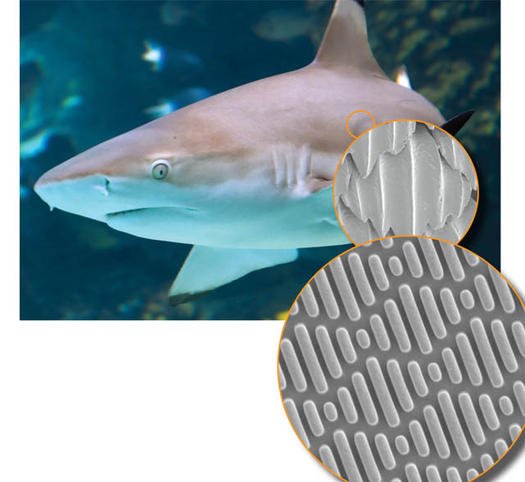
But perhaps more exciting than bio-inspired treatments are some of the clever natural mechanisms being leveraged to keep pathogens and injuries at bay. For instance, Florida-based Sharklet Technologies realized that shark skin possesses a unique texture that doesn’t allow bacteria and other organism to take hold. By duplicating this unique pattern on an adhesive synthetic sheet, Sharklet has created a bacteria-free surface that can be used in hospitals, restaurants, and other places where contamination has consequences.


What’s more, because this technique doesn’t kill bacteria it will be far more difficult for them to evolve a resistance to it, sidestepping the core problem with most attempts at rendering bacteria harmless. After all, the root technology underwent a 400-million-year incubation period in the ocean, and bacteria haven't figured out how to thwart it yet.

Energy: Nature Already has a Smart Grid


Devising a practical and efficient means of harnessing photosynthesis is quite possibly THE Holy Grail of energy research, but it's not the only way biomimicry has the potential to change the global energy paradigm. Biomimicry has the potential to rewire the entire world for cheap and abundant energy by informing the design of smart grids and other energy infrastructure.


One company is doing so not by looking to plants, but to insects like ants and bees. Toronto-based Regen Energy has been exploring “swarm logic” for several years now, developing software based on the working principles an insect swarm--that is, that each individual node in the system doesn’t need a direct order from the leader to act in a way that maximizes benefit to the entire network.


By mimicking swarm intelligence, the company has already developed a means to manage energy networks like the HVAC systems in large buildings to reduce peak electrical demand. And just a few weeks ago Regen announced that the Los Angeles Department of Water & Power is considering tapping swarm logic to help manage its DOE-funded Smart Grid EV integration project, bringing hive mentality to one of America’s largest public utilities.

Information Technology: Mimicking Natural Networks


Ants and bees aren’t just informing energy grids. “Some of the early successes in biomimicry already have come from millions of dollars saved by mimicking how an ant communicates information and translating that into how you send server packets over the Web or how you pick a route for your trucks to drive or something like that,” McGee says. 


There’s plenty more to learn; researchers at Pacific Northwest National Laboratory have developed a computer network security system based on the swarm intelligence ants use to defend their hills, and going all the way back to 2007 researchers inspired by honeybee communications built a system that lets networks optimize performance by taking advantage of idle servers during periods of high demand. But McGee thinks we’ve just scratched the surface of what biology can do for IT.


“We’ve already seen an explosion in the relationship between understanding biology using information sciences and then developing ideas in information sciences based on biological insight,” he says. “I think there’s still a lot of room there to play with computer science and biology by learning from biological systems.”

 by "environment clean generations"


Selasa, 30 Agustus 2011

Some New Life Form Lives On Arsenic


  • Bacterium in a lab thrived despite substituting one of the six building blocks of life.  

  • The finding has implications for the search for life beyond Earth -- as well as the prospect that alternative forms of life may exist on the home planet as well.

  • Scientists weaned a strain of bacteriaoff of phosphorus, leaving them to do-or-die with arsenic. Surprisingly, they lived.  

Strange bacteria living deep in a California lake can survive on arsenic and can even grow by incorporating the element into its DNA and cell membranes.


"It has solved the challenge of being alive in a very different way than we knew of," said lead researcher Felisa Wolfe-Simon, a biochemist with the U.S. Geological Survey in Menlo Park, Calif. 

GFAJ-1 is no Frankenstein monster. It's a bacterium scooped up from the salty sediments of Mono Lake in California that seems to have pulled off a major scrambling of its building blocks for life -- something scientists didn't think possible.

The finding not only presents the possibility that alternative life forms can exist, or once existed, on Earth. It opens the floodgates for scientists developing techniques to identify alien life, if it exists. And it raises the prospect of alternative methods for wastewater treatment and bio-energy production.


"The implications are profound, regardless. The building blocks of life are more flexible that we had previously thought," astrobiologist Ariel Anbar, with Arizona State University.


The life forms in question, GFAJ-1 of the Halomonadaceae family of Gamoproteobacteria -- like all living things -- were dependent on oxygen, carbon, hydrogen, nitrogen, phosphorus and sulfur to exist. But in the laboratory of Wolfe-Simon, a NASA astrobiology research fellow, the organisms learned to live with arsenic instead of phosphorus.


"Are the organisms actually doing this in Mono Lake, or do they have the latent ability to do so? That's an interesting question to pursue," said Anbar, a co-author of the study.

Analysis showed the transition was more than cosmetic. The microbes seem to have incorporated arsenic into their DNA. Wolfe-Simon accomplished this by not replenishing the phosphorus in their laboratory environment, forcing them to make do, or die, in a liquid that became increasingly more concentrated in arsenic, which from a molecular perspective, closely resembles phosphorus.

Surprisingly, the colony lived and grew.


"Nothing should have grown," Wolfe-Simon told reporters. "It was amazing. We have a microbe doing something different than life as we know it. We've cracked open the door to what's possible elsewhere in the universe."


Steven Benner, with the Foundation for Applied Molecular Evolution in Gainesville, Fla., would like to see more detailed studies on the chemistry, including radioactive tracers to map the location of arsenic in cells.

"Chemists think this is an exceptional result, and therefore chemists will, like Carl Sagan says, require exceptional evidence to prove it," Benner said.


If the study holds up, it could lead to a change in how phosphates are used and managed on Earth.

"Phosphate-based fertilizers are one of the pillars of the green revolution," said chemist James Elser, also with Arizona State. "They are limited in a lot of different ecosystems. Organisms rely on phosphorus to build nucleic acids and other molecules to grow and proliferate."

"Phosphorus is a big issue for sustainability and the quality of aquatic ecosystems. When it leaks out of systems, out of agricultural systems, it functions as a pollutant," Elser added. "It's really exciting to think about the possibilities that are raised by a clever organism that evolved a way to do without phosphorus, possibly... and how it might be used in wastewater treatment, recovering phosphorus from various sources, in bio-energy production."


The finding also will spur NASA to rethink how it goes about looking for life, particularly on Mars, the target for a new rover packed with biology and chemistry experiments that is due to be launched next year.

"It makes me have to expand my notion of what environmental constituents might enable habitability," said Pamela Conrad, a Mars Science Lab co-investigator with NASA's Goddard Space Flight Center in Greenbelt, Md.


"Perhaps arsenic is not an essential component for habitability or for life, but it may be one that can be tolerated," she added. "And that opens up our perspective to try to understand what other potential components might be tolerated, or in fact even essential, that we presently haven't thought of."

 by "environment clean generations"